An admissions planning system for homeschool families.
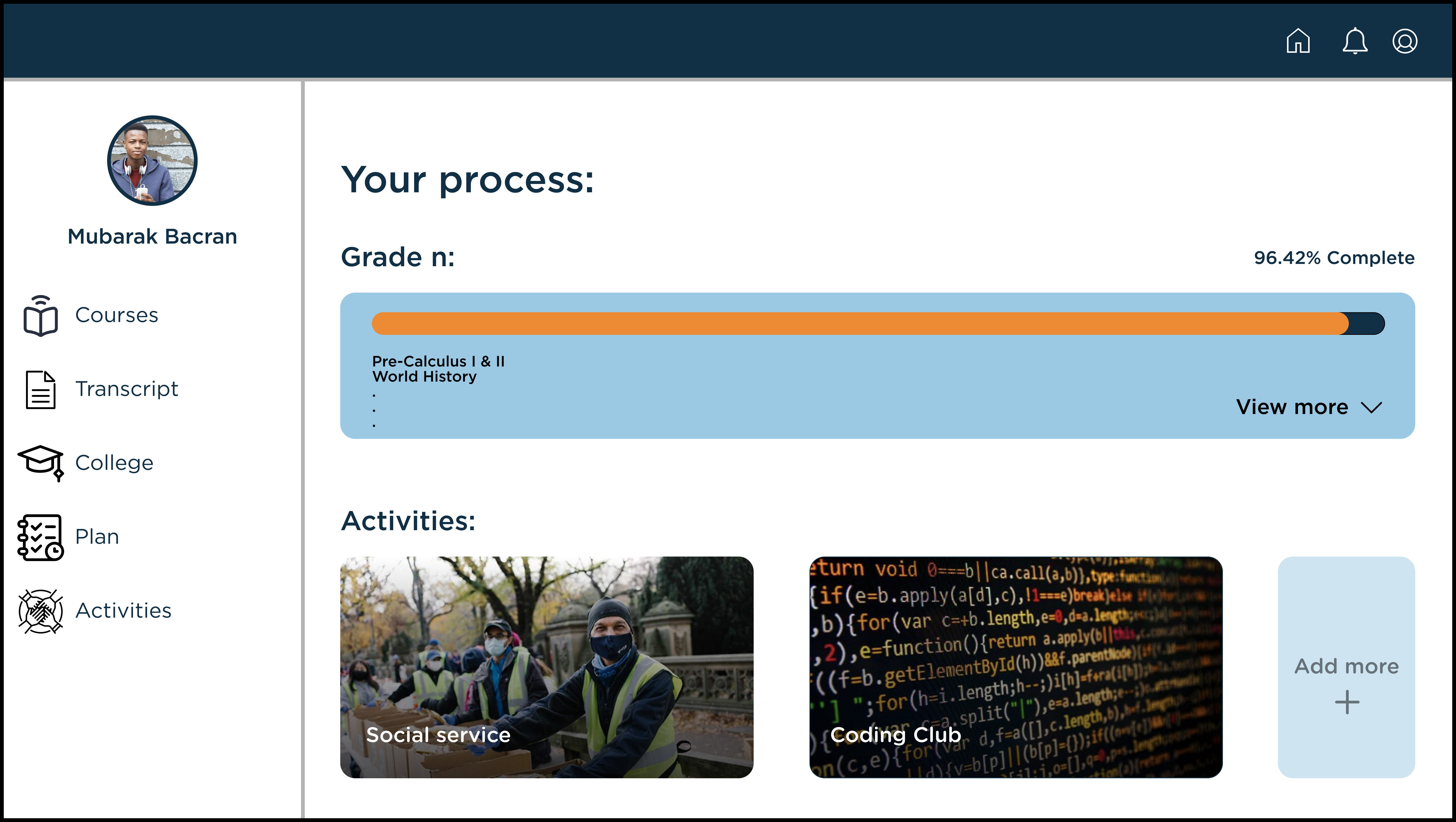
Four planning tracks in one view. Transcript, testing, activities, and applications, all visible without switching screens.
No infrastructure. Every family builds it from scratch.
A homeschool family applying to college sits at the kitchen table with a browser open to twelve tabs: the Common App, the HSLDA forums, a spreadsheet someone shared in a Facebook group, and a Word doc that is supposed to become a transcript but looks nothing like one.
Nobody coached them on what a transcript should look like. Nobody told them their state has different graduation requirements than the college's expectations. And the one consultant who handles homeschool families in their area charges $4,000 minimum for a full engagement most families cannot afford.
Families were not missing effort. They were missing one trusted system.
Four decisions that shaped the design.
Not every design choice was obvious. These four decisions changed the direction of the product, each one a harder build but a better one.
Existing tools for homeschool families are either generic (College Confidential forums, HSLDA guides) or expensive (private consultants at $4–10K). Neither solves the core problem: a single family trying to navigate school-specific requirements for multiple applications over four years. The product had to eliminate lookup work, not just organize it.
Families would only act on information they trusted. Every data point in the product needed a source, a date, and a way to verify it independently. The interface had to feel like a reference, not a recommendation engine. That meant sourced citations on requirement cards, school-specific policies checked and dated, and no generated summaries without a link to the original document.
Early wireframes defaulted to a parent-as-manager model: parent sees everything, student gets a task list. That gets the relationship backwards for high school juniors and seniors. The student view became the primary interface; parents join by invitation, see progress and deadlines, and can add context. The student's planning space stays theirs.
AI can surface requirements, flag gaps, and draft essay scaffolding. It cannot guarantee that a specific admissions officer will accept a non-traditional transcript. High-stakes review needs a human fallback. The product routes edge cases, transcript exceptions, and final application review to vetted human experts on-demand, preserving AI efficiency while removing the ceiling on trust.
Trust through restraint.
Families arrive anxious. The interface had to feel calm and authoritative, the opposite of the cluttered, forum-based tools most families currently use. A white surface; one signal color reserved strictly for active states and critical deadlines; type hierarchy that lets families find their next action without scanning. The planning data layer uses a calm blue family drawn from HCAP's palette: legible, structured, and distinct from the signal red used for deadlines.
From zero schools to an application-ready plan.
Four planning tracks visible at once: transcript, testing, activities, applications. Families get a full progress overview without navigating between views. Families who can see where they are in the larger arc are more likely to continue than families who only see the next action.
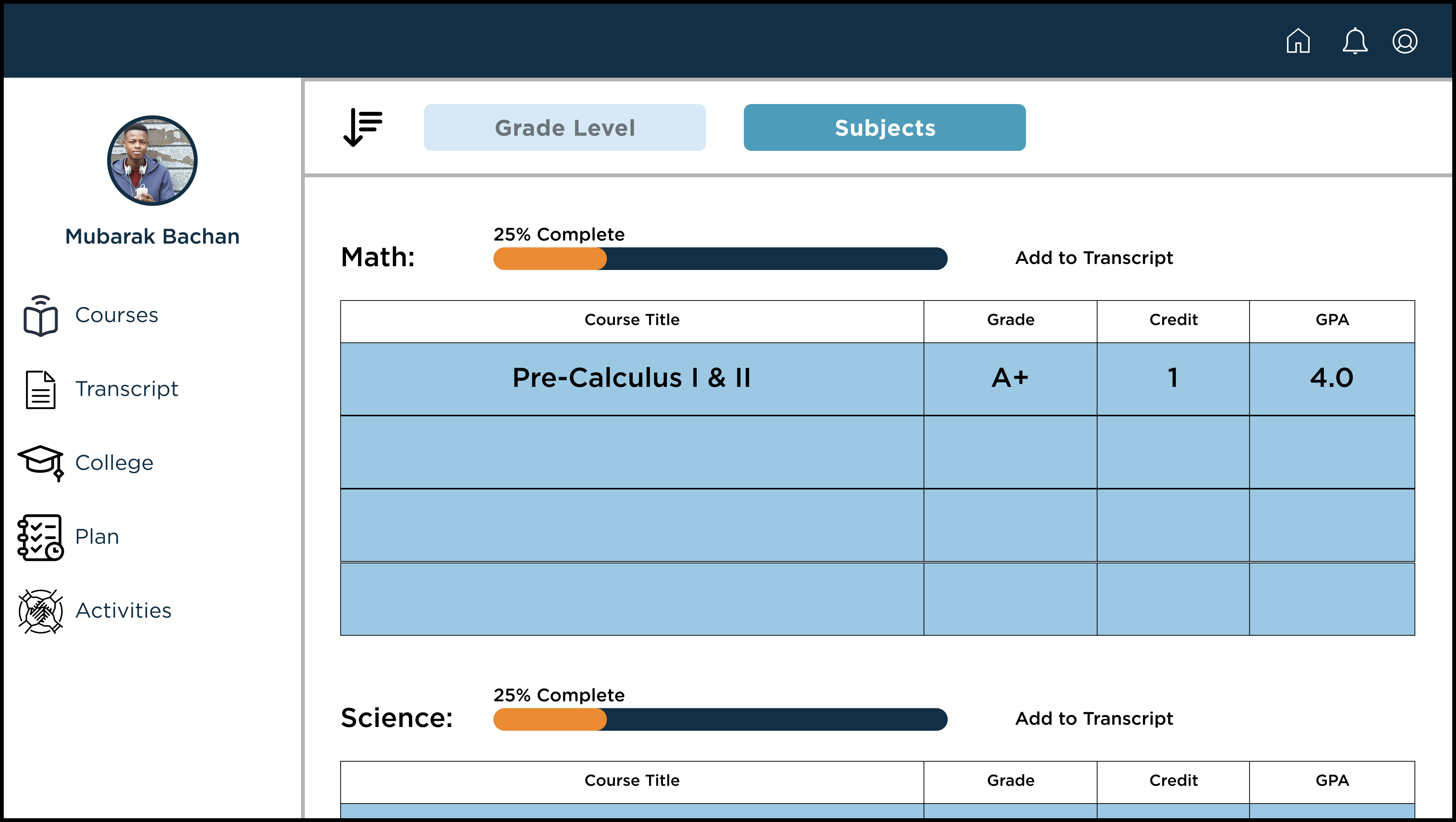
Structured category templates replace the blank transcript form. Each category is pre-structured but fully editable: completing a form rather than writing a document. Paralysis drops when a user is filling in a structure rather than inventing one.
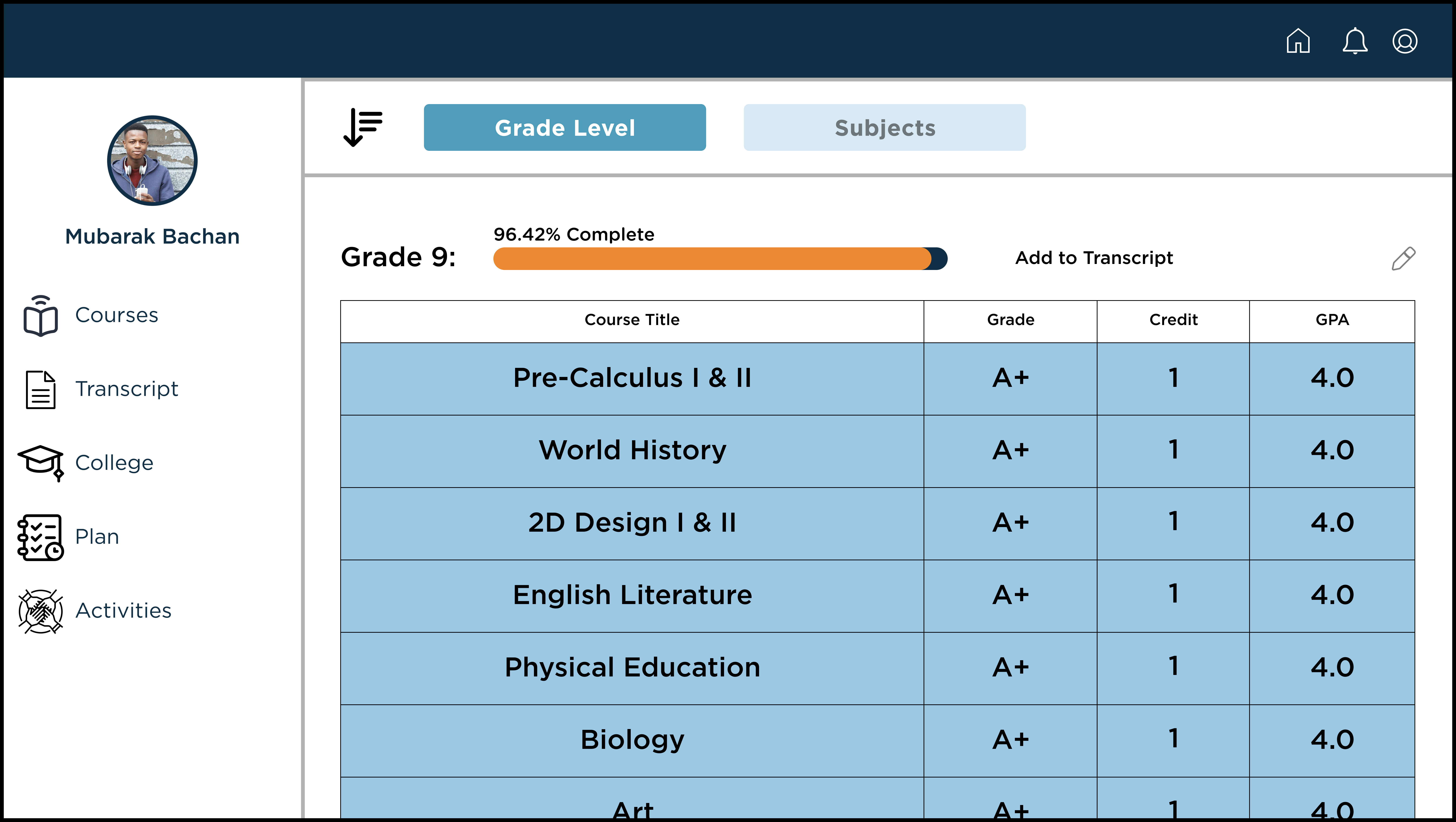
Deadline visibility across a multi-year horizon, sequenced by school and application cycle. Families see where they are in the larger arc before seeing the next task: context before action.
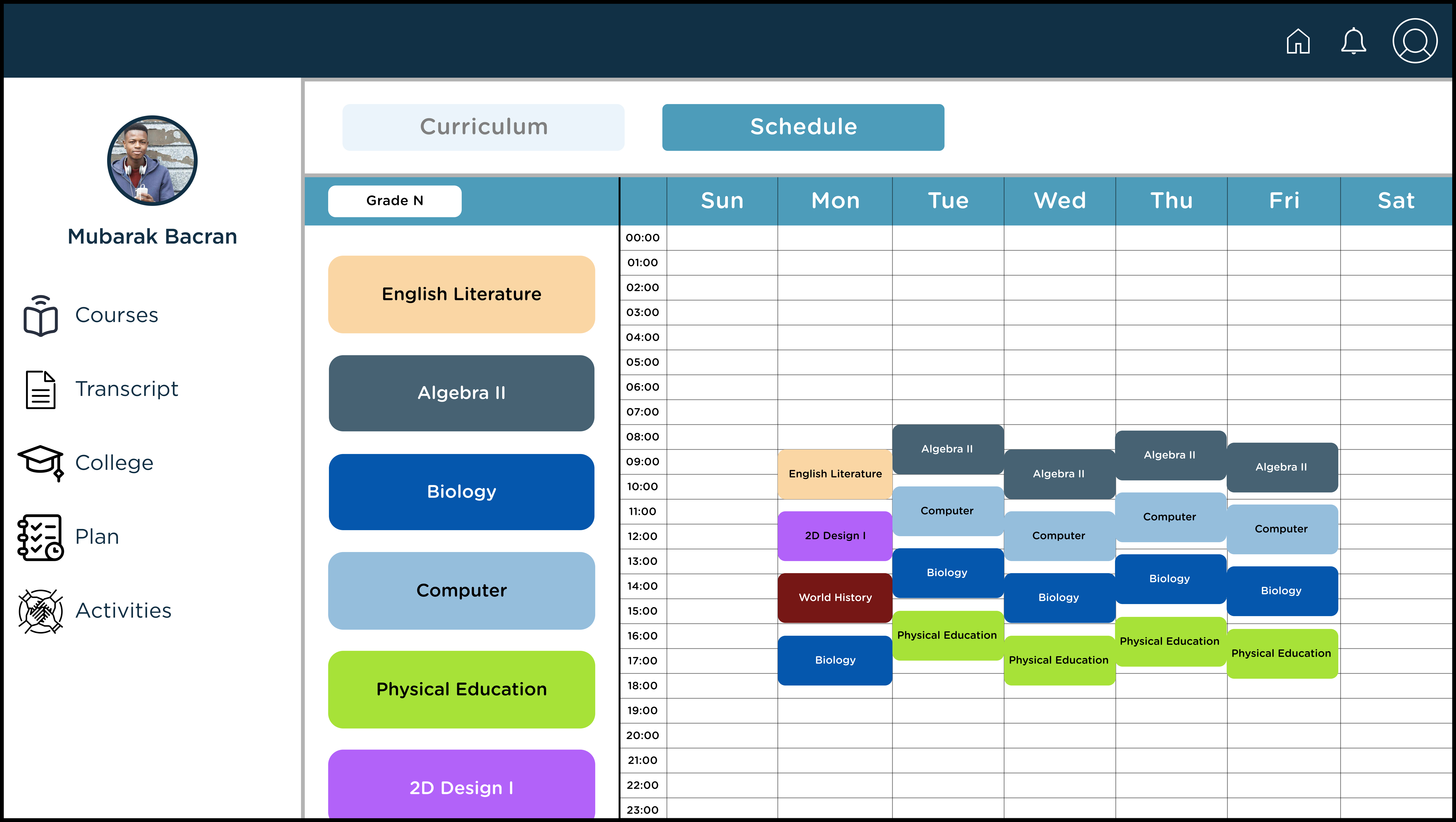
A focused daily view for students, stripped to: next three tasks, upcoming deadlines, one progress signal. Separated from the parent planning layer to remove irrelevant noise. Students and parents have different planning horizons and different tasks.
AI as a first pass. People reveal the rest.
AI flagged structure and hierarchy issues across the student, parent, and advisor interfaces. Human feedback revealed where the emotional stakes of college admissions raised the trust threshold and where the AI copilot framing required more explanation than the UI provided at first pass.
- Heuristic review of student, parent, and advisor flows through the shared planning environment
- Accessibility and contrast checks across requirement maps, credit matcher, and essay coach
- Edge-case states: missing transcript, incomplete requirements, deadline conflict states
- Clarity of AI-assisted suggestions versus verified factual requirement data throughout
- Human expert review handoff: is the scope and trigger point clear to the family
- Families needed clearer separation between AI-generated suggestions and source-verified requirements
- The parent invitation flow felt secondary rather than primary in early versions
- Trust required seeing a named human expert in the review layer, not just a service tier label
- Students responded better to the task view when daily actions were separated from long-range planning
- The essay coach framing needed to emphasize "not a ghostwriter" more explicitly to reduce concern
The trust gap specific to high-stakes educational decisions. AI confirmed the information hierarchy was clear. People revealed that for a decision as consequential as college admissions, families needed to understand the source and recency of every piece of requirement data before trusting any recommendation built on top of it. Labeling the sourcing layer explicitly changed the trust response more than any layout decision did.
Designed, not shipped. A concept with a clear path forward.
HCAP is a portfolio concept, not a launched product. The outcome is a design system and architecture that makes a real problem solvable, and a validated market position with a clear path to early revenue.
The homeschool admissions segment is underserved by every major platform. A direct-to-family product enters from below the consulting market and scales into the broader K–12 college planning space.
Sourced, dateable, verifiable requirement data is a moat. Families who trust the data will not switch to a faster but less verifiable tool. Trust compounds as the data improves.
At $399 for a self-serve planning package or $999 for a full package with two hours of human expert review, the product undercuts private consulting (avg $4–10K) while delivering more structured, personalized planning than any forum or blog can provide.
The right validation step before automating anything: charge real families for a hand-built version, delivered by a human expert using the HCAP planning framework. Willingness to pay at $399 or $999, not just interest, determines whether the product is worth building.
The first version assumes a conventional path.
The planning system is built around the common scenario: a homeschool student in a structured curriculum, applying to four or five U.S. colleges on a standard senior-year timeline. That covers most of the market. But it quietly fails several real users who are already at a disadvantage.
If I revisited this, I would treat exceptions as first-class flows earlier, not edge cases to retrofit later. Transfer students, gap-year applicants, students applying to international institutions, neurodivergent students who don't track on a typical academic sequence, and families applying across very different college systems all deserve a purpose-built path, not a workaround inside a conventional one.